To be truthful, I may not be the best example to tell you about the bare minimum of tools that you would need, because I’m a serial over-preparer and over-packer. When I’m preparing a game night with friends, my car is usually full with games and games and games. Too many games actually. I don’t know what it is, that I want to be prepared for any situation imaginable… And even then, unimaginable things happen. Yes, there might not be a large TV nearby, so maybe I can just show the screen of my iPad when I only prepared a map digitally. Or have everyone’s character sheet printed out myself because I know that at least one will forget them. Yes, I might have an issue. But I don’t want that you will have an issue, when you’re preparing for your first sessions. So let’s dive in.
Your first adventure
At that point the question is, what do you currently have at your disposal. First of all, you don’t need to buy every adventure book that exist. That would also be quite expensive. You don’t need to have an adventure book per se. But you should have a general understanding what your player group wants to play. Do they want High Fantasy politics? Do they want exploration in dark dungeons? Or do they just want to slice and dice lots of monsters? All of those would fall under one of the major pillar of high fantasy role-playing-games like D&D: exploration, social encounters and combat. Ideally, in a balanced session, those should be spread equally among the adventure. And then of course the general question: Is this just a one-shot or a small mini campaign to get into the groove?
Official starter sets were quite easy to get in the past. Dragons of Stormwreck Isle were available for less than 20 bucks. But since it will be replaced by the 2024-ruleset themed new starter campaign Heroes of the Borderlands, you would have to invest around $50 now for an entry-level adventure set. Usually those would also be accompanied by additional tools like dice sets, a small DM screen, pre-generated character sheets, item cards and a dedicated added book for rules, there’s usually no printed out battle map or small minifigures or tokens included (Note: It seems like Heroes of the Borderlands will have just that as well in its box, but again, with a bigger price tag). Similarly, the box set for Mausritter (also available for ~ $50) contains the main rule book, item cards and sets, as well as a small adventure zine. Or if you want to have a more alien adventure, the Starter Box for Mothership is around ~$50 and for more Star Trek-related things, the second edition starter set is available for around $30. Most of them have item tokens, maps or dice included. Usually, they are quite simple to get and have an adventure module with them, as well as a reduced ruleset. Those are mostly for a short mini campaign, usually have 3-4 chapters which would keep your group in action for a few sessions. Note, with the pre-generated characters, it might be quickly to get playing much more quickly, but a lot of player agency and customization is taken away. For example, some of the characters in the Dragons of Stormwreck Isle campaign have personal interests to visit a cloister and some adventure hooks are basically designed explicitly them. When I played this campaign with a new set of players, I wanted to test this out, how they would react and how they would incorporate this and I am glad that I have made this bad experience because there are better ways to do this. Let the players create their characters quickly on D&D Beyond (ok, „quickly“, I know) and then hand out customized „tasks“ or additional backgrounds that you have extracted from the pre-made characters that are adventure-specific.
On the DM’s guild there are also many adventures targeted for Level 1 characters and one adventure in particular that I liked was „The Fall of Elturel“ which was sort of a prequel to Baldur’s Gate: Descend into Avernus. It was pretty solidly scaled, had lots of social encounters, lots of exploration and a hefty final boss battle encounter at the end. We played it in person and half-digitally, when I had the map on my iPad and presented them with small icons that I would shift on my MacBook. It looked complicated but it worked. It would have also worked, if I had just printed out the map and placed some markers or tokens on it.

A quick and simple idea for your own one-shot adventure
But after the last few starter topics, let’s discuss a different path and let’s design a starter adventure from scratch. All you need to do is to have some fantasy and maybe some tools you’d have here and there. On D&D Beyond, you automatically have access to something called „Basic Rules“. This is based on the so-called SRD (Systems Reference Document) and contain a basic set of characters, NPCs and monsters. Then, you could think of a basic structure for your adventure. First of all, most adventures begin in a tavern, with characters sitting together, drinking and eating, while looking for their next adventure. As they sit there, they probably start talking to the waiter or another person that is currently in the tavern.
„Oh, it’s interesting to see people from outside here in this town again. We haven’t had any visitors since many people started walking away into the desert and haven’t been seen again since.“
Your players will ask many questions now. What has happened? Has something happened in the town that would make them leave town? What could be the reason? Do they have friends or family that have gone missing? And so on. At that point, let’s have a step back, because YOU, as a DM, knows what happens by the end of the story. Let’s say a harpy has made its nest close to the city and whenever its hungry, it performs a luring song and makes succeptible people walk into its trap. He managed to lure in a few people that were walking outside the city as they were playing or gathering mushrooms and put them inside of some cages. These would be his food if winter would come and he would start to starve. But if a harpy is not for you, you might also try to find other simple monsters that are manageable for your players (either via DND Beyond’s Encounter Creator or third-party tools such as Goblinist or Kobold Fight Club).
So, that’s the inciting incident („People are missing“), a hook for the players („Let’s find them“) and a potential evil creature as the final boss battle. The rest is pretty straightforward: Create a few more NPC characters, a few hints where to go, some obstacles that might be distracting and a logical path that would bring them to the final boss battle and that’s basically it.
Let’s talk NPCs: They might be persons that have known one of the missing persons. They might have seen something. They might have found traces. They might have heard similar stories in the past. Think about the potential information they could bring to the player characters and then make a basic persona. For example, the mother who has lost her son and wants you to find him. She was outside with him, gathering mushrooms, as he was playing in the forest and suddenly he was gone. Another inhabitant of the city might have lost his wife, as she wanted to walk her dog. A third one has ordered some important books from another city but the delivery guy has never reached the city. You could pepper out additional characteristics, about how they look, how they talk and other things, but truth be told, most of the stuff, you’ll make up on the spot. Lots of things you do as a DM is highly improvisational and on the spot just as the situation demands it. Then, you might think about where you’ll meet them. At their house for example, or at work or they just happen to be sitting in the same tavern at the same time, crying in the background.
Then, they start gathering hints about the threat. Someone has heard a strange song being sung in the distance. Someone might have seen remains of dead carcasses of half-eaten animals. Someone might have noticed that valuable items such as rings or diamonds have disappeared as well. Maybe someone has heard about a harpy in another city.
Eventually, your players would have enough information (and weapons) to get out into the wilderness and catch this harpy. They might have to traces some paths, find additional remains, hints about the harpy’s nest. Maybe have an additional encounter with wild boars or other wild animals before eventually finding the harpy.
Once you have the story ready, you can think about the necessary ingredients for this adventure that you would need as a DM.
First of all, have the statblocks of your potential creatures ready that you might encounter in a combat situation. These might be
- Harpy
- Boar
- Wolf
- anything else you want to throw against your players (but be careful: Don’t throw dozens of enemies at them with higher CR level, or else you’d end up in a total party wipe scenario)
Familiarize with those statblocks and the unique fighting styles and abilities that the creature have. The harpy is a creature that can fly, but most of their attacks are melee attacks, that means the harpy must attack an enemy directly in close combat. This, however, looks different if they are using Luring Song before, which charms any character failing their Wisdom Saving Throws. If you want to learn about tactics of monsters, there is a fantastic blog named „The monsters know what they’re doing“, it has specific entries for nearly all monsters, also for the harpy (There’s also a book series, collecting most entries).
Other necessary tools
Maybe prepare a simple map depending on where the final encounter will take place, like maybe in a forest environment or in a cave (don’t forget to bring light in there). Whenever stuff happens, try to be as dynamic with your environment as possible. In the forest you could have deep water puddles after a rainy night before, which would make the terrain difficult and the harpy might be flying from tree to tree. But here, a simple graph paper is working just fine. There are tons of websites that would offer maps to download and print out, if you really want to have something tactile, but don’t make it too complicated.
And then just roll with it. You’ll probably have 2-3 hours of fun with such a simple setup. So my simple suggestion is to have lots of pens, papers, dice and some notes. That’s what you’d need most. Then again, you’d have additional stuff, like a DM screen in order to hide your notes and spoilery material from the players. A map for encounter scenarios (or simple graph paper). Some blank character sheets if you also want to create characters in the same session (or you could have those pregenerated from DND Beyond). Some blank pieces of paper for notes. Snacks. Lots of snacks. And then you’re basically good to go. You don’t need to have a quantity of books or minis for having lots of fun with your friends. Of course, they enhance the playing experience, but you don’t have to go full Matt Mercer on your players with a large 3D map sponsored by WizKids. A simple piece of graph paper is also good enough.
But at the end of the day, D&D for a DM is one thing: Research and Planning. You think about the capabilities of your player characters, what has happened in your world and what would they would have to do to deal with this threat. If you start thinking about the ceiling color of that utility store that your players have to visit to get weapons and items, you’re doing too much detail. Just do it on the fly when someone’s asking. You don’t need to have every detail ready. In any case, you can make it up as long as you go. No one knows what you have behind your DM screen, right? But, also keep honest with your players. If someone wants to jump on a owlbear and ride on its back, they might try that, but then would have to face the consequences if something goes horribly wrong.
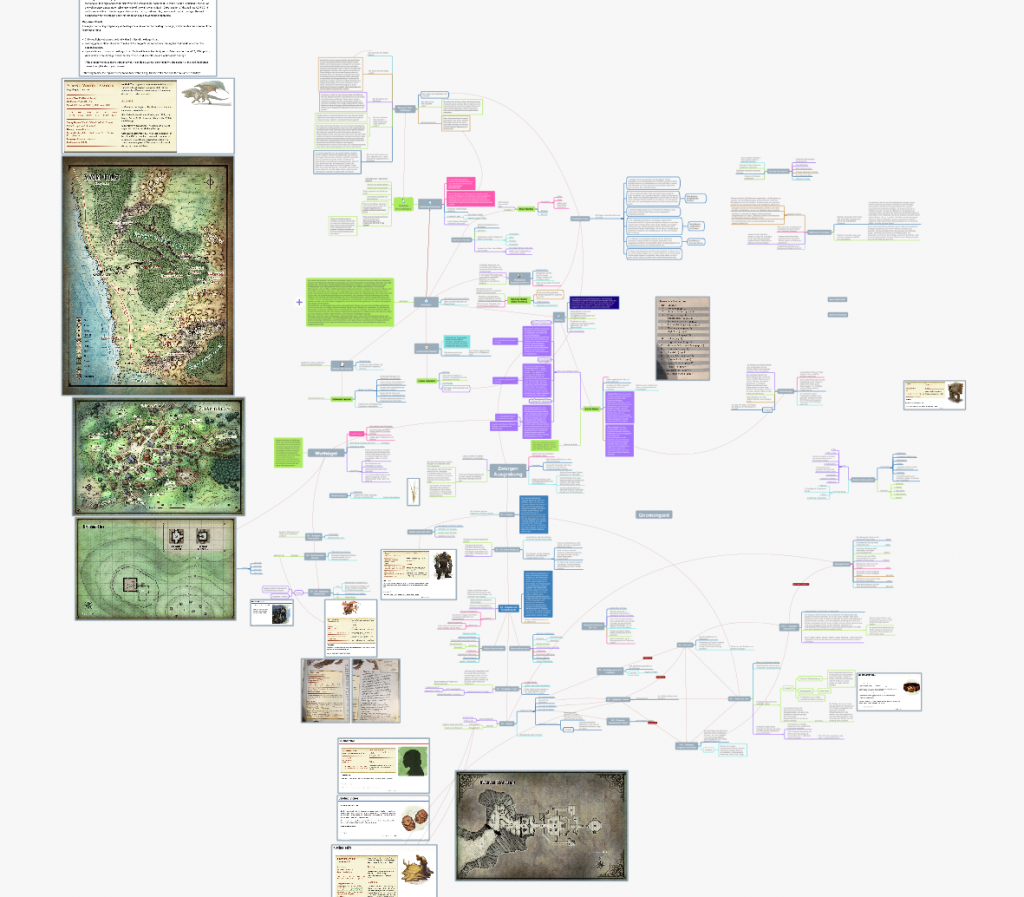
I hope I have taken away some of the fear if you’re trying to have your first session. I know, the material is incredibly intimidating. The rules, the world, the characters. I spent weeks to prepare for my first session. But eventually I figured out what to do and what to expect. And I HORRIBLY OVERPREPARED. Here’s a screenshot of my mindmap that I built in Mindnote just for the beginning of Dragon of Icespire Peak. I’ve made multiple fallbacks and potentials and what if scenarios that I derailed myself once my players started to do something which I had not foreseen. And that was the first thing that I learnt from this first session: You can’t plan everything in advance. You can’t estimate what stupid ideas your players might have and might follow. So take a step back and have your adventure as simple as possible and only with time you can add more and more detail. Because for example, that one person that went missing who should deliver some books. Maybe those books contain some secrets for the next session.
Next time, we will talk a little bit about player agency, pacing, plot twists and what you can do for your session 0.